(A Chapter from my Travel Memoir – ‘The Roads Along the Sea: The Malabar and Coromandel Coasts’)
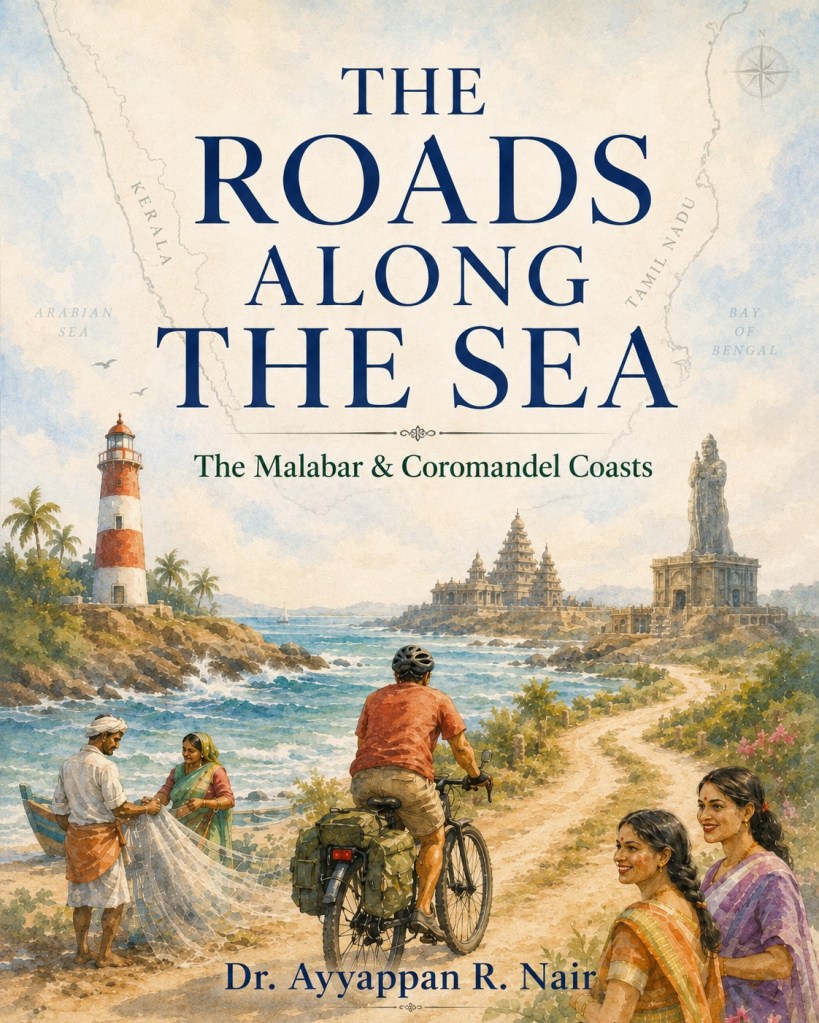
Travel loosens the grip of certainty. Long hours on the road create spaces where the mind wanders freely. Landscapes gradually turn into reflections. As the ride unfolded along the coasts of Kerala and Tamil Nadu, I began to notice how deeply one idea kept surfacing, in different clothes, again and again: nothing stays as it is. The land itself seemed to tell that story. Rivers shifted their courses, shorelines advanced and retreated, and towns that once flourished faded or vanished altogether. The great flood of 1341 is traditionally believed to have redirected the Periyar, reshaping the Muziris-Kochi coastline and helping create the harbour that would eventually become Kochi. Ports that once welcomed ships from distant lands now lie silent or buried beneath sand or water. Poompuhar, once a thriving Chola port, has partly surrendered itself to the sea. Korkai, the ancient centre of the Pandyan pearl trade, now sits quietly inland as the water slowly withdraws from it. And at Dhanushkodi, the skeletal remains of a once-thriving town still stand exposed to wind and tide, reminders of the cyclone of 1964 that erased an entire settlement in a single night. Alongside these older upheavals sit others with a distinctly human hand behind them. In many places beaches have visibly retreated as erosion reshapes the shore. Harbours, breakwaters, and expanding towns alter coastal currents. Fishermen sometimes speak of the sea advancing where it once held its distance. Rising sea levels, though gradual, no longer feel like distant projections but quiet realities along the edges of villages and fields. Even the air near expanding towns and ports feels heavier than what older generations remember. Even the great kingdoms that shaped these coasts—the Cheras, Cholas, Pandyas, Pallavas, Nayaks, Marathas, and the European colonial powers—rose, flourished, and eventually gave way to others. The land and its record of kingdoms seem to move to the same rhythm. What one generation builds, another reshapes. What appears permanent slowly yields to the quiet pressure of time. The coast, in many ways, keeps its own ledger of this. Nothing remains entirely fixed. Even the lighthouses, which appear so permanent against the horizon, have themselves replaced earlier structures, adapting to newer technologies and maritime needs. The more I thought about it, the more I began to sense that upheaval, unwelcome as it may look in the moment, often carries within it the seeds of possibility. Nature offers a quiet lesson here. Evolution itself depends on small variations in the code of life. Most pass unnoticed, but occasionally one allows life to adapt and move forward. Perhaps the past follows a similar pattern. What looks like disorder at first may also be the beginning of something new. Civilizations turn over, landscapes remake themselves, and societies adjust in ways rarely visible while they are happening. These thoughts unfolded against a world that was itself far from settled. When I began cycling through Kerala, the pandemic had only just begun to loosen its grip on daily life. Roads were opening again, yet traces of those shut-in months lingered everywhere. Shops reopened cautiously. People returned slowly to work. Conversations often drifted toward what had been lost, what had held on, and what had quietly become different. And yet what struck me most along the coast was people’s stubbornness in getting on with things. Fishermen had returned to the sea, their boats pushing out once again with the morning tide. Small roadside tea stalls reopened beside the road, welcoming travellers with the same simple hospitality that had long defined these routes. Life had been interrupted, but not extinguished. There was a quiet determination in the way people resumed their routines, as though the land and the sea themselves offered a reminder that ordinary life tends to outlast whatever disturbs it. As I prepared to begin the Tamil Nadu leg, the world was again shaken by events far beyond these shores. Russia had invaded Ukraine. I heard about it in fragments—a line on someone’s radio, a comment traded over tea at a roadside stall—and the distance between that war and this coast felt, at once, enormous and oddly thin. Villages here went on with their morning routines exactly as before; elsewhere, human beings were once again turning against one another. It struck me, not for the first time, how easily war seems to arrive compared to how hard peace is to keep. It doesn’t need agreement from everyone—only enough ambition, fear, or misunderstanding in the right hands to set something in motion that then runs on its own. Yet the places I rode through had absorbed centuries of exactly this—contest and accommodation, kingdoms rising and falling, coastlines and communities remade again and again. Watching the fishermen go about their morning as if nothing elsewhere mattered, I wondered if what we call peace is really just the pause between one such upheaval and the next. What seems to have changed is only the pace. What once took generations to unfold now seems to happen within a handful of years—less the slow work of tide and season, more the restless push of human hands. And yet something else carries across these cycles: what people choose to remember. Each age leaves its trace on the one that follows. These impressions travel quietly from generation to generation, shaping how communities see themselves and their place in the world. Sometimes they survive as songs, stories, and customs. At other times they endure through ritual and worship. And sometimes they persist simply as habits whose origins no one can any longer explain. Along the coast, these traces sit everywhere, side by side. Old temples stand beside new roads. Churches and mosques built centuries ago still welcome worshippers whose ancestors once stood in the very same spot. Fishing communities carry forward rhythms of work that have outlasted storms, trade, and shifting rulers. Yet amid all this, another pattern kept showing itself with equal clarity: people, wherever I went, were fundamentally decent to a stranger on a bicycle. It showed up in directions offered unasked, in tea pressed into my hands, in the pride fishermen took in their boats and nets, and in the plain curiosity of those who stopped to ask where I’d started and where I meant to end up. By the time the ride began to draw toward its close, another set of thoughts slowly surfaced. Although the pages of this book do not dwell on them, there were many stretches that carried real discomfort. Days when fatigue pressed heavily, when the weather turned unfriendly, when the next night’s shelter remained uncertain until late in the evening. Yet again and again something intervened. A stranger appeared or called at the right moment. A sudden shift in weather made the ride easier than it had any right to be. A small decision, made almost without thinking, later turned out to have steered me clear of real trouble. Any one of these, alone, is easy to dismiss as coincidence. Strung together, mile after mile, they were harder to wave off so easily. Was it merely chance? Or was something quieter at work? I found myself wondering, more than once, whether these small mercies added up to a kind of guidance—perhaps even something close to grace, offered without ever announcing itself. The road gave no answers. Only time to sit with the question. Gradually I noticed that my own relationship with not-knowing had shifted. Earlier in life I had usually met a difficulty by pushing back against it, trying to bend circumstance through sheer effort. This ride suggested something quieter. Effort still mattered. So did preparation. But there were also moments when letting go seemed the wiser move, not the weaker one. Perhaps not everything needs to be fought. Some things simply need to be understood. Rather than resisting what looks inevitable, perhaps the better task is to recognize it—maybe even to work with it. The rivers I crossed don’t fight their own bends. The shore doesn’t resist its own erosion and rebuilding. A forest grows, falls, and grows again without complaint. Life, at every scale, moves forward by yielding as much as by pushing. Perhaps a life is not so different. What unsettles us is not always only loss. Sometimes it is the beginning of something else. By the time the final kilometres passed beneath my wheels, these thoughts had settled quietly into me. I hadn’t found answers, nor uncovered any secret buried in the landscapes I’d crossed. But something had shifted. I no longer felt the same urge to brace against every uncertainty. Instead, I began to sense that a life goes best when effort and acceptance move together—working diligently at what is in front of you, while staying open to whatever current is actually carrying you. Throughout the ride, lighthouses had marked my path along the coast. They stood quietly above rocks and sand, guiding ships through waters that never stopped moving. Each one offered a fixed point in a world otherwise being constantly rewritten by wind, tide, and time. Perhaps a life needs something similar. Not a tight grip on every turn of the road, but a steady inner light—something that lets us keep moving even when the horizon itself won’t hold still. And perhaps a kind of peace arrives when we stop treating the ride itself, with all its detours and surprises, as something to be resisted. Like the tides along the coast, it simply unfolds.
https://a.co/d/0j5XAh0d (India)
https://a.co/d/05TAJQ0O (Global)

